‘Not for Sale’: Rare Earths Pitch Ignites Debate Over US-Myanmar Engagement
- Kay
- March 13, 2026
- March, Metals, News, Rare Earth
- 0 Comments
As American diplomacy dramatically shifts under President Trump, experts warn of “major policy ramifications” in Myanmar.
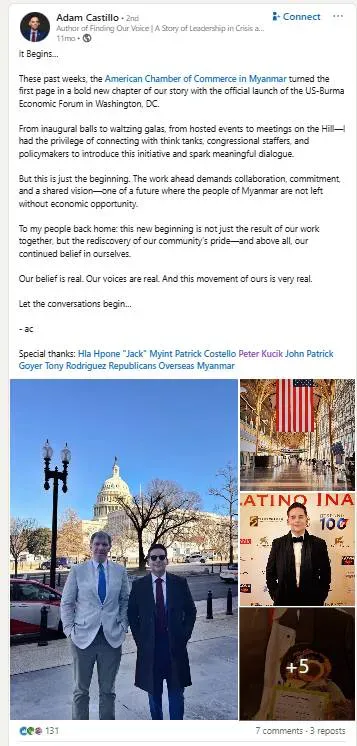
On July 17 last year, an American businessman named Adam Castillo visited the White House. Speaking to advisors of Vice President J.D. Vance, he pitched options for the United States to seek access to Myanmar’s rare earths.
Following the meeting, he told Reuters that he had urged U.S. officials to broker a “bilateral self-governance deal” between the Myanmar military and the Kachin Independence Army (KIA), which controls the rare earth mining hub of Pangwa on Myanmar’s northeastern border with China.
According to the Reuters report, he also suggested the U.S. could strike a deal with the KIA to send rare earths mined in its territory to India for processing and eventual export to the U.S.
Myanmar’s 2021 military coup and the violent crackdowns on the peaceful protests that followed triggered a widespread armed uprising. The KIA is one of several longstanding ethnic armies that have joined this uprising. Like many anti-junta groups, it has refused to enter peace talks on the military’s terms.
Analysts have warned that any U.S. attempt to access Myanmar’s rare earths would run into major logistical and geopolitical barriers. The U.S. may have found similarly: so far, it has not announced any intent to pursue rare earths mined in Myanmar.
Interviews with 17 people for this article, however, indicate that the act of pitching Myanmar’s rare earths to the White House is indicative of bigger trends.
Most of those interviewed – including former U.S. officials, sanctions and policy experts, businesspeople, and democracy and human rights advocates – spoke off-the-record or on condition of anonymity, fearing personal or professional backlash.
“This is fertile ground right now,” said a natural resources specialist, who has worked on U.S.-Myanmar policy for more than a decade. “People see this as a transactional administration that only thinks about what benefits the U.S., so people who have goals around Burma are engaging in it that way.”
Burma was the country’s official name until 1989. It is still used by some, including the U.S. government, despite the military’s opposition.
A sought-after commodity
In recent years, Myanmar’s rare earths have become increasingly vital to global markets.
While China once mined most of the world’s supply domestically, disastrous environmental and health impacts led the government to tighten regulations beginning in the early 2010s. Many Chinese investors turned to Myanmar, where they could operate free of such constraints.
Research by the environmental watchdog Global Witness and others has found that Chinese investors typically partner with local businesspeople and armed groups on Myanmar’s eastern border to mine rare earths with little transparency, trucking the raw material into China for processing.
A growing body of research and reporting has linked the industry to deadly landslides and water contamination with toxic chemicals, among other harmful impacts.
In 2022, Global Witness found that Myanmar had eclipsed China as the world’s largest source of heavy rare earths, a subset of rare earth elements used in the manufacture of electric vehicles, wind turbines, and precision-guided weapons.
China still holds most of the world’s rare earth processing facilities, and has leveraged this control over the past year, restricting rare earth exports in response to steep U.S. tariffs on Chinese goods.
The Trump Administration has, in turn, pushed deals that could grant it rare earth mining access from Greenland to Ukraine to Pakistan, and signed agreements with countries including Australia, Japan, Malaysia, and Thailand to cooperate in building supply chains.
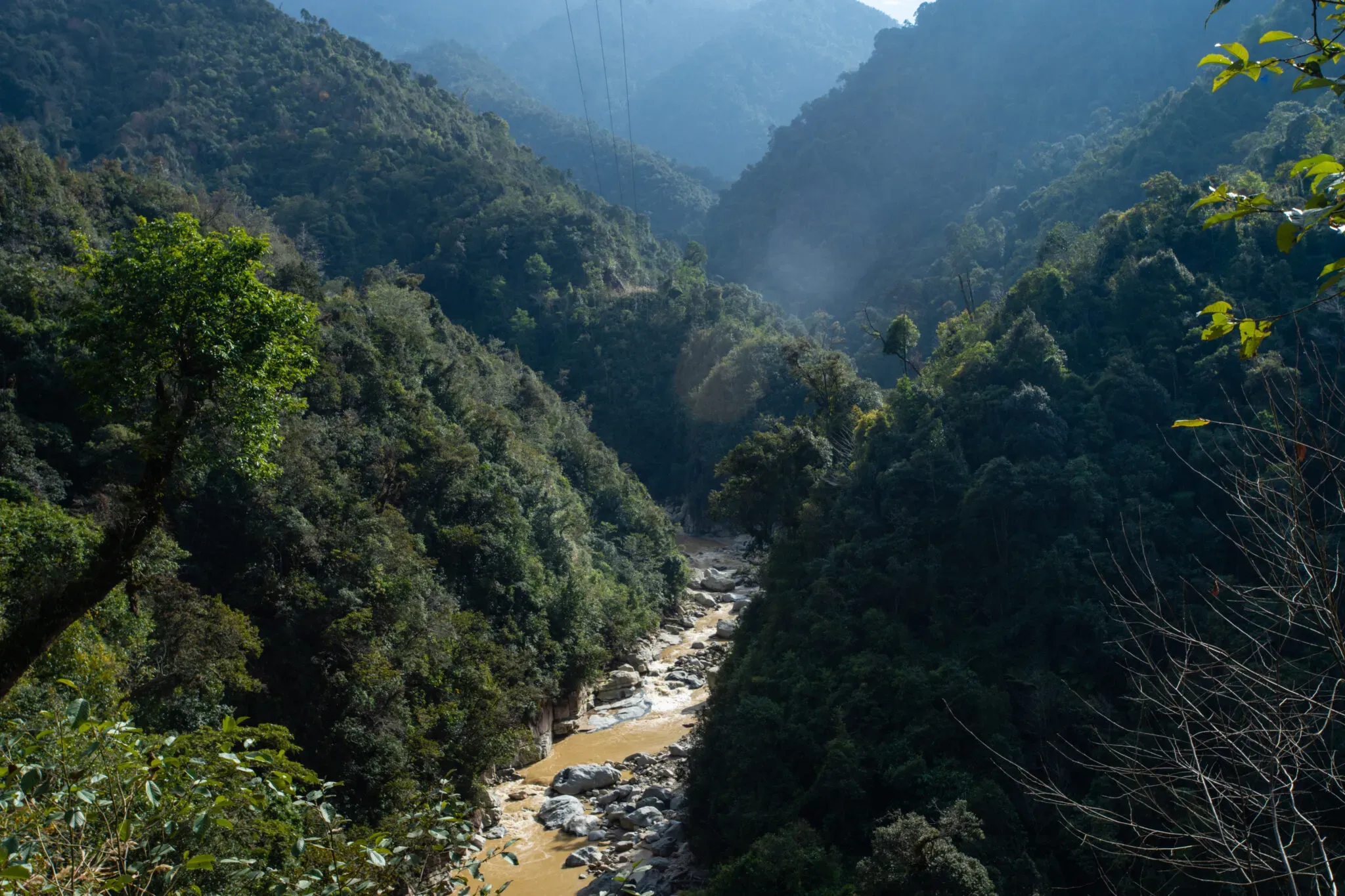
Were the U.S. to try accessing Myanmar’s rare earths via India, however, experts say it would likely face significant challenges. Among them, it would have to transport the unprocessed material across remote, mountainous areas where competition over land and resources has contributed to decades of armed conflict.
Fighting has intensified since the 2021 coup, creating new funding demands alongside a push for control over contested territory. In 2024, the KIA seized Pangwa from a military ally.
The KIA’s political counterpart, the Kachin Independence Organization (KIO), maintains that it has not issued new rare earth mining permits since, but announced this January that it had reached an agreement with Chinese companies already operating in the area to abide by certain environmental standards.
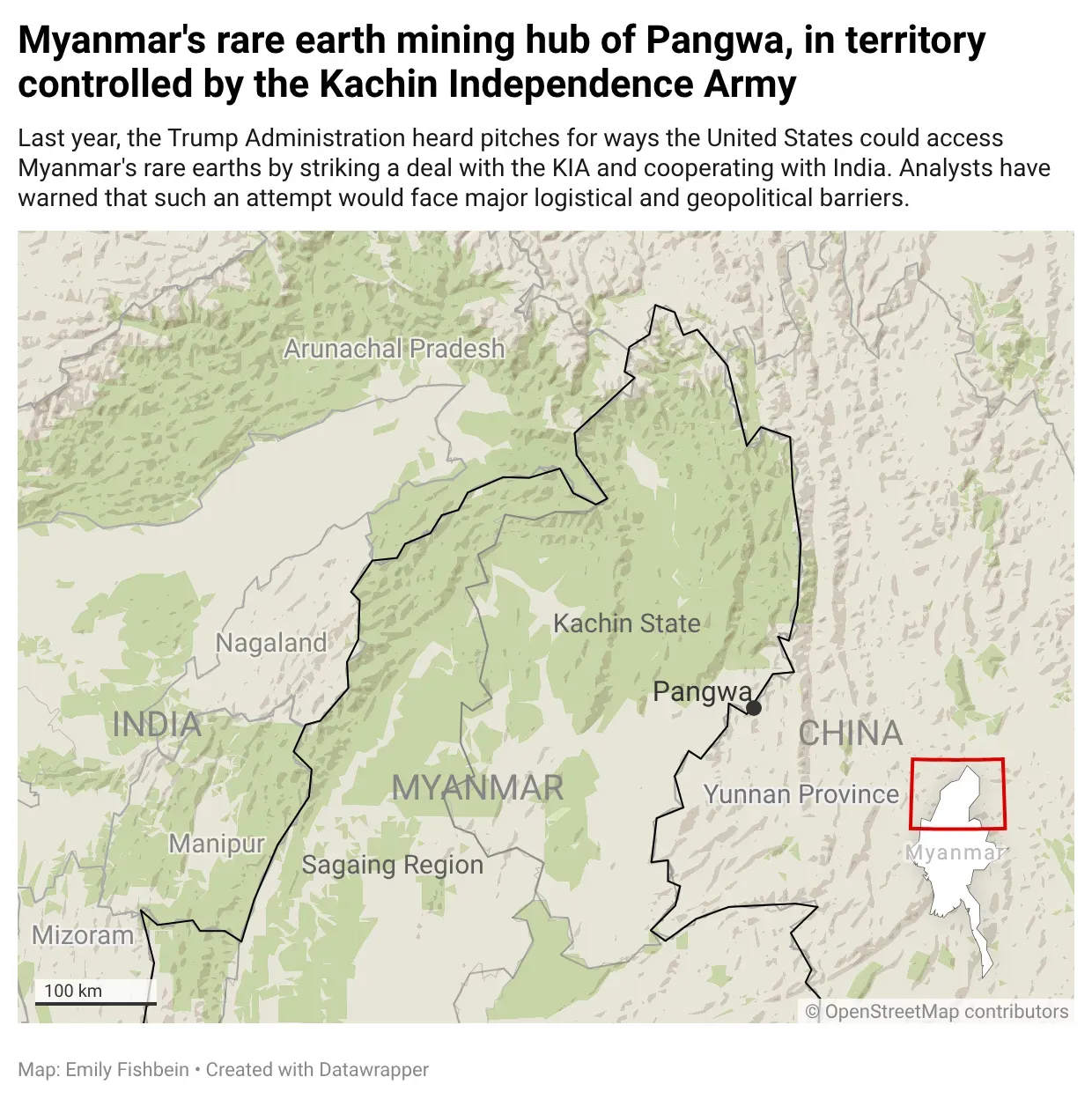
Even if the U.S. were to transport rare earth mined in Myanmar to India, processing would present another obstacle.
Although Reuters reported last year that India had sent officials from its state-owned rare earth mining and refining firm to KIA-controlled territory in December of 2024, it also reported that India lacked the processing facilities necessary to produce rare earth magnets on a commercial scale.
Then there are the international geopolitical considerations. India-U.S. relations have been tenuous over the past year, and India and China have only recently reinstated diplomatic relations following a deadly flare-up at their disputed border in 2022.
According to Angshuman Choudhury, a PhD candidate at the National University of Singapore and King’s College London who specialises in India-Myanmar relations and border politics, India “may not want to join forces with [the] U.S. in an area right next to China to extract and ferry something as high stakes as critical minerals.”
At the same time, he noted that a U.S.-India trade deal signed on February 9, alongside India’s recent decision to join a U.S.-led alliance to secure the global artificial intelligence supply chain, may signify a shift.
“While northern Myanmar may not supply critical minerals required to build core AI chips, India’s participation shows its willingness to do the U.S. bidding,” he said, adding that India may also want to diversify its own rare earths supply chain.
“The recent India-China rapprochement opens up ways for both to quietly cooperate on procuring rare earths from northern Myanmar, although Beijing would certainly want to preserve its dominance in the region,” he said.
A high-risk jurisdiction
In recent months, new calls have emerged for the U.S. to pursue Myanmar’s rare earths.
In January, Dave Brat, an American economist and former Republican congressman, wrote an opinion piece for a conservative daily news outlet Washington Times, suggesting the U.S. could invest in “energy and critical mineral opportunities in Myanmar” as part of a “realistic, strategic recalibration” of its engagement in the country. The article was republished in the junta-run Global New Light of Myanmar.
Then, in February, Wesley Alexander Hill of the International Tax and Investment Center published an article in Forbes making a similar argument.
While a focus on rare earths is relatively new, Americans trying to make deals and access resources in Myanmar goes back at least to when the country began to emerge from international isolation in the early 2010s, according to the natural resources specialist.
He said that at the time, factors including U.S. reporting requirements, Myanmar’s nascent legal and regulatory frameworks, and its opaque business and financial environment left Americans generally more cautious than investors from China and some other Asian countries.
Still, some Americans were “trying to find ways to access this seemingly untapped market,” he said.
Foreign investments accelerated during Myanmar’s political and economic opening over the following decade, but were significantly hampered by the 2021 coup.
Western sanctions followed, and in 2022, the Financial Action Task Force, an intergovernmental body seeking to combat money laundering and terrorism financing, added Myanmar to its blacklist of “high-risk jurisdictions” alongside North Korea and Iran.
In 2023, the U.S. Treasury Department sanctioned two Myanmar junta-run banks, claiming they had facilitated domestic foreign currency exchanges and enabled the military’s transactions with foreign markets, including for the purchase and import of weapons.
“We will continue to support the people of Burma and deny the regime access to the means to perpetuate ongoing atrocities,” said a Treasury Department representative in the announcement.
Major policy ramifications
Sources interviewed for this article expressed concern that the days in which human rights and democracy featured prominently in U.S.-Myanmar policy had ended under Trump.
Last year, as the Myanmar junta prepared for staged national elections, it hired two American lobbying firms to help it develop diplomatic relations with the U.S. International observers cast the elections as a bid for diplomatic recognition; although backed by China and Russia, they were denounced by human rights groups and most Western governments as a sham.
When the military-backed party claimed victory after ensuring its biggest rivals did not participate, even the Association of Southeast Asian Nations, a regional bloc which has faced criticism for its perceived soft response to the Myanmar coup, refused to recognise the results.
But the U.S., which has limited its comments on foreign elections under Trump, did not issue a statement.
“Normally, the U.S. would be leading the charge, publicly branding the elections as not credible,” said Scot Marciel, who served as the U.S. ambassador to Myanmar from 2016 to 2020. “The fact that it’s not reflects the Administration’s lack of interest in defending or promoting democracy.”
Billy Ford, a peacebuilding and governance fellow at the Southeast Asia Peace Institute who formerly worked as Burma Program Officer at the U.S. Institute of Peace, warned that massive cuts to foreign aid and the U.S. State Department have left gaps in oversight that could undermine decades of American diplomacy promoting democracy and human rights in Myanmar.
“The hollowing out of the State Department has eliminated the very officials who might have resisted myopic policy recommendations by corporate lobbyists that run counter to U.S. policy and America’s long-term interests,” he said, without referring to specific cases.
Meanwhile, the U.S. National Security Council – a body with a mandate to undertake policy coordination – has also been significantly diminished under the Trump Administration.
“Without robust interagency coordination, it will be very difficult for people making decisions to obtain adequate information,” said Henrietta Levin, who formerly served as the National Security Council’s Director for Southeast Asia and is now a senior fellow with the Center for Strategic and International Studies.
“Especially in addressing complex crises like the situation in Myanmar, this will have major policy ramifications,” she said.
A representative of the Vice President’s Office, who some sources said was involved in an ongoing Myanmar policy review, did not reply to an emailed request for comments.
Advocacy highlights
Adam Castillo declined to comment for this article.
On his LinkedIn profile and website, he identifies as the founder, owner, and chair of AGS Myanmar, a “security risk management firm.” He also claims to be the founder and chair of the Myanmar chapter of Republicans Overseas, and the author of the forthcoming book Finding Our Voice | A Story of Leadership in Crisis and the American Spirit Abroad.
From 2023 until May of 2025, he served as president of the American Chamber of Commerce in Myanmar (AMCHAM), an influential business association.
He also claims on his LinkedIn to have founded the US-Burma Economic Forum. An announcement for the forum’s launch event, held in Washington DC in January of 2025, describes it as “a new era of AMCHAM Myanmar advocacy,” with Castillo listed as the event’s only confirmed speaker.
An outline for an AMCHAM general meeting chaired by Castillo just before his term as president ended last May, provided by a source who was invited to the meeting, gives a sense of the forum’s objectives.
A section titled “US-Burma Economic Forum: 2025 Advocacy Highlights” describes warning U.S. lawmakers against bills calling for sanctions on Myanmar’s financial sector and making a case that Myanmar’s economic isolation “cedes the field to other external actors – and forfeits strategic leverage”.
It also calls on AMCHAM to “continue to be vocal about the adverse effects of Myanmar’s FATF blacklisting and sanctions” on the country’s “economic opportunity.”
It’s a controversial position. In June 2024, United Nations-appointed Special Rapporteur on the situation of human rights in Myanmar, Tom Andrews, published a report which found that financial institutions involved with Myanmar junta-owned banks were at a high risk of enabling its attacks on civilians, and that the junta’s Ministry of Defence at times made use of private banks.
The report called on UN member states to strengthen their coordinated sanctions, and on all financial institutions to end or freeze their relationships with Myanmar junta-owned banks.
Months after the release of Andrews’ report, AMCHAM enlisted outside support for its advocacy, U.S. lobbying disclosure forms show. These forms do not make any reference to sanctions.
They do show that in December 2024, AMCHAM hired Mercury Public Affairs, LLC, a U.S.-based firm, to advocate for “issues related to American business promotion and connection in Myanmar,” and that AMCHAM went on to pay US$290,000 to Mercury up until August last year, when AMCHAM and Mercury ended their agreement.
Mercury Public Affairs is a self-described “leading global, bipartisan public strategy firm.” From 2022 to 2024, the co-chair of its Washington, DC office was Susie Wiles, a prominent Republican political strategist who currently serves as Chief of Staff to President Trump.
According to The New York Times, she severed ties with Mercury shortly after being named White House Chief of Staff in November 2024. Wiles has no known relationship to AMCHAM’s Myanmar lobbying.
One of two people working on the AMCHAM account for Mercury was Peter Kucik, managing director of Mercury’s Washington, DC office.
According to his LinkedIn profile, he served as senior sanctions policy advisor for the U.S. Department of the Treasury’s Office of Foreign Assets Control from 2007 to 2014, when he “played a key role” in implementing sanctions for Myanmar.
In 2022, Kucik wrote an opinion article for Frontier Myanmar, a local independent media outlet, arguing that Myanmar’s FATF blacklisting was likely to harm the general public, while the junta found workarounds for its illicit financing.
Then in 2023, he told Frontier Myanmar that U.S. sanctions on Myanmar state-owned banks would hurt ordinary citizens and businesses more than the military.
Kucik also claims on LinkedIn to have served, since 2017, as “Of Counsel” to Ferrari & Associates, a law firm specialising in U.S. sanctions. His profile does not provide further details about his relationship with the firm, and he is not listed on Ferrari & Associates’ website.
The firm’s founder and director, Erich Ferrari, posted on LinkedIn in July to announce his firm’s success with a “triple removal action.” “Very happy for our clients removed today, and very proud of our team of attorneys and investigators that worked on these matters,” he wrote.
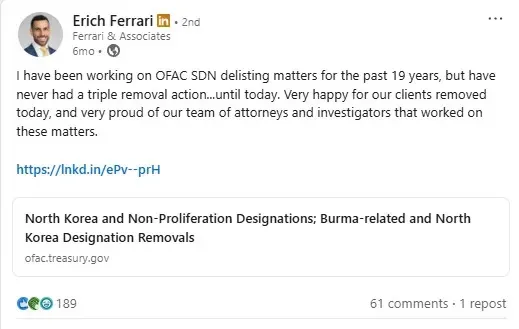
His post linked to a U.S. Treasury Department statement that it had removed sanctions on multiple people and companies with ties to Myanmar and North Korea. Ferrari later told the Insight Myanmar podcast that his firm represented three Myanmar clients on the list, without specifying which ones.
The delisting drew outcry from human rights advocates, including Tom Andrews, who called the decision “a major step backward for international efforts to save lives by restricting the murderous junta’s access to weapons.”
Multiple sources familiar with U.S. sanctions policy noted that the timeline and protocols for sanctions-related decisions are designed to ensure decisions are reached independent of outside influence, with sanctioned individuals prohibited from hiring lobbyists and the Treasury Department’s Office of Foreign Assets Control (OFAC) typically conducting extensive research in consultation with other government agencies, including the State Department.
Some sources, however, expressed concern about the opacity of the July delistings within the current political environment.
Neither Ferrari nor Kucik replied to emailed requests for comment. Ferrari deleted his LinkedIn post about the “triple removal action” sometime on or after January 28, 2026, when he was contacted by email for this article.
The U.S. Treasury Department did not reply to an emailed request for comment. OFAC asserts on its website that the “power and integrity” of its sanctions “derive not only from its ability to designate and add persons to sanctions lists,” but also from its “willingness to remove persons from such lists consistent with the law.”
“The ultimate goal of sanctions is not to punish, but to bring about a positive change in behavior,” it says. “Maintaining the integrity of U.S. sanctions is a high priority for OFAC and is the driving principle behind its rigorous review process that evaluates every request for removal individually on its merits and applies consistent standards to all of them.”
Future of rare earth mining in Kachin
Sanctions aside, the future of the rare earth mining industry in Myanmar remains uncertain.
In 2023, public protests led the KIO to cancel a rare earth mining project in its territory. It has since pledged to respect local people and the environment, but has not published a formal policy on rare earth mining or transparency mechanisms.
For decades, Kachin’s jade, land, forests, and other resources have funded both the KIO and its opponents, while enriching local elites and their Chinese business partners. The public, meanwhile, has suffered from chronic war and underdevelopment, while rural households have endured the additional burdens of land dispossession and environmental degradation.
While the Kachin economy is closely tied to China, the U.S. has also exerted a strong historical influence. Baptist missionaries from the U.S. brought a written language to Kachin people at the turn of the 19th century; Kachin soldiers fought alongside Americans against the Japanese during World War II.
“Our history, religious foundations and collective identity, the way we think and live, have been deeply influenced and shaped by the American people,” said a Kachin activist, speaking on condition of anonymity.
Despite this cultural affinity, he emphasized that any U.S. engagement in Kachin must be predicated on promoting democracy and human rights, and on treating local people, land, and resources with dignity and respect.
“Our land is not for sale,” he said. “This is about respecting mutual interests and standing for our own values.”