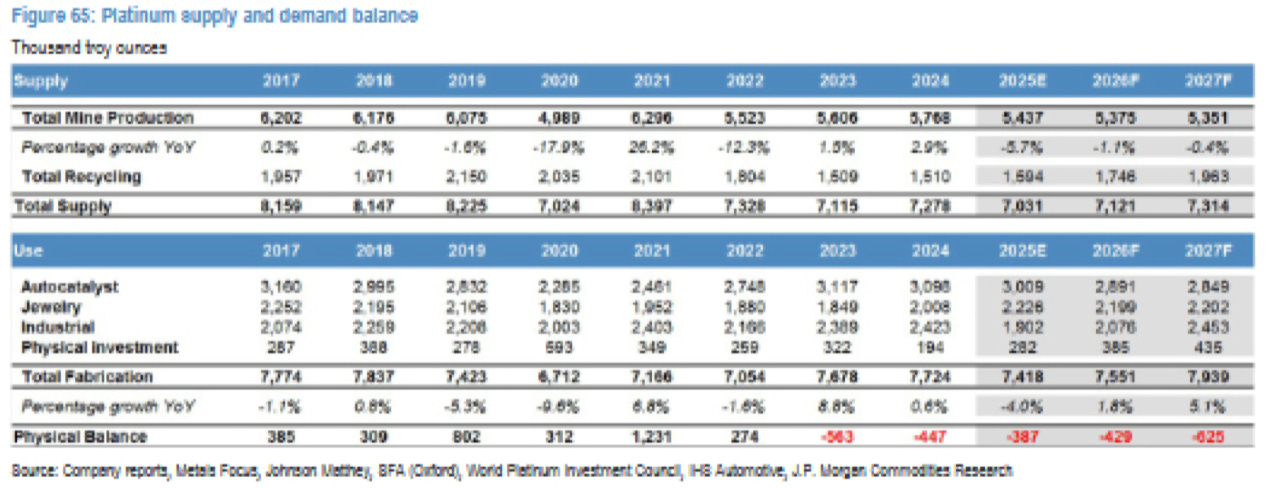
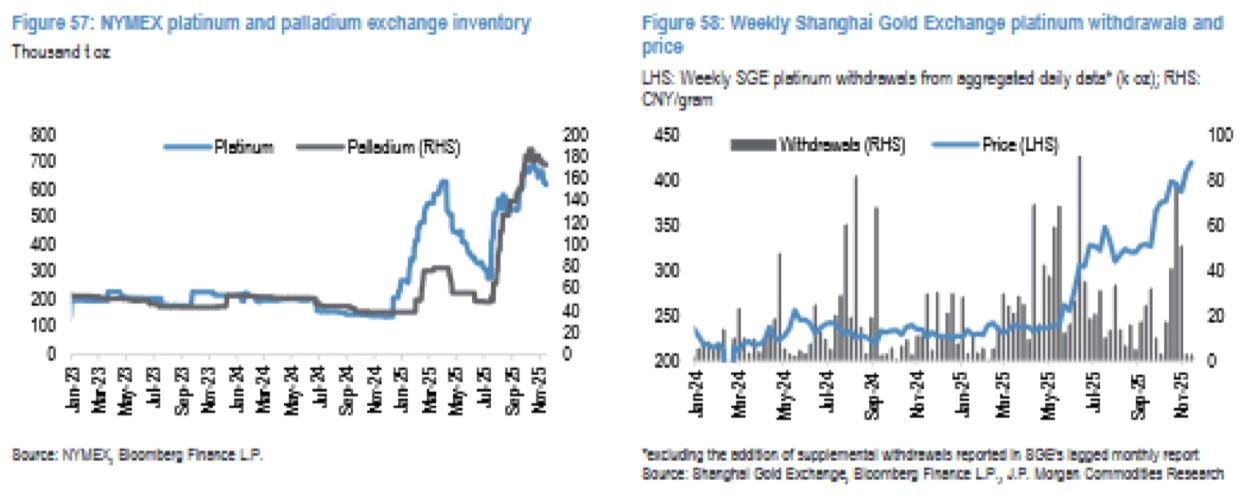
- Platinum prices are high enough to begin to turn the gears of supply rebalancing but this will take time and, in the interim, we still see a deficit market and a further rally in gold supporting platinum prices to average $1,670/oz in 2026.
JPM Says “Platinum, Higher for Longer”
- Kay
- December 9, 2025
- December, Metals, News, Platinum Metals
- 0 Comments
View: Source
(photo credit: PR)
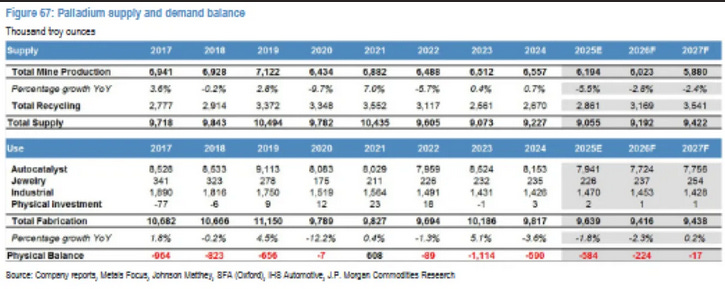
- In the near-term, tariff risk is most acute in palladium, which will continue to drive upside to prices in the coming months. Beyond this, however, we still see a palladium market where structurally weaker demand growth is expected to bring the market back towards balance by 2027, pressuring palladium prices back towards $1,150/oz by the end of 2026.
Despite improved producer margins, a return to mine supply growth will still take time. Mine supply across the PGMs is still slated for a decline in both 2026 & 2027, with platinum and palladium mine supply forecast to decline by -1% and -3% yoy next year, respectively. Even though producer margin pressures have eased given the rise in platinum prices this year, we still see limited mine supply growth prospects in the near-term. This year alone, platinum mine supply is estimated to contract by -6% yoy in South Africa amid heavy rainfall in 1Q25 which caused flooding across the mines and led to operational difficulties. While higher prices this year and throughout our forecast horizon take the pressure off producer margins and are likely to be high enough to allow greater sustaining and expansion capex spending, it still likely won’t materially alter the overall supply picture in the coming years, as prolonged underinvestment in the sector has led to a weak project pipeline which will take time to refill.
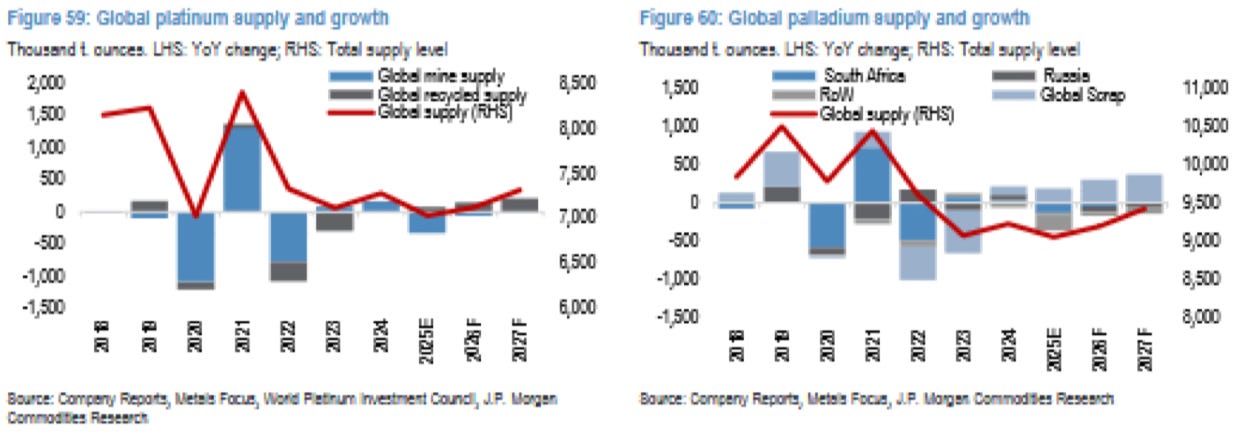
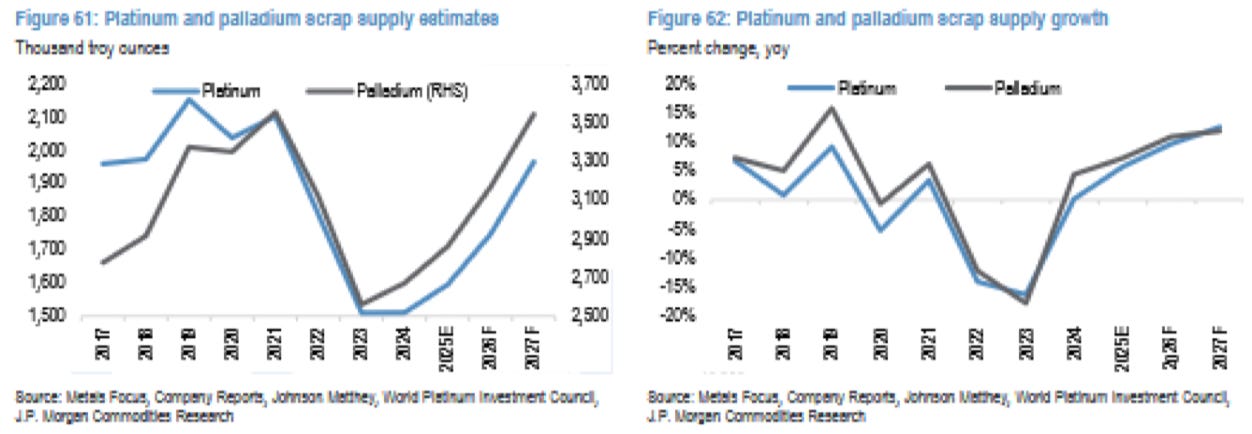
Scrap will do the heavy lifting for supply growth in 2026/27. After a prolonged period of extended vehicle ownership times followed by hoarding by scrap yards waiting for better prices, scrap supply is finally growing again as recyclers are seeing more end-of-life vehicles entering the recycling pipeline. An increase in vehicle scrappage over the next two years, combined with greater incentives to release scrap at higher prices, is expected to further expand the rebound in PGM recycled supply. In turn, scrap growth works to offset a continued fall in platinum and palladium mine supply. Global passenger vehicle sales rose by 5.2% yoy YTD through October, and we expect the momentum in strong vehicle sales this year to continue into 2026, which means older vehicles will be moving to either second-hand car markets or scrap yards. Net-net, this is supportive for PGM autocat recycling. With more vehicles appearing at scrap yards this year, autocat recycling across platinum and palladium is forecasted to be up by 6-7%. Additionally, China’s roll out of a scrappage scheme which allows vehicle owners to receive a subsidy when an older ICE vehicle is scrapped to purchase a new electric vehicle has supported autocat recycling in the country this year. For 2026, we see higher scrap processing rates, increased capacity and higher PGM prices driving our forecast for 10% yoy growth in platinum and palladium autocat recycling, with this growth rate expected to further expand in 2027 (Figure 61 & Figure 62).
Autocatalyst demand continues to face headwinds. S&P Global forecasts a -0.5% yoy decline in global light vehicle production in 2026 and we expect this to drive a yoy decrease of about 120 k oz and 220 k oz in platinum and palladium autocatalyst demand next year, respectively, as our estimates of catalyst-containing vehicles falls by around 3% yoy (Figure 63). Despite headwinds from auto tariffs in the US earlier this year, global light vehicle production is actually forecast to grow by 2% yoy this year. However, with this growth almost exclusively driven by China where PGM loadings are leaner and BEV share much higher, we forecast autocatalyst demand for platinum and palladium to be down by around 3% yoy this year. 2026 looks challenging too with contractions in light vehicle production expected across all the main regions. Moreover, China’s rapid expansion in BEV production and improved sales over the course of this year is accelerating the pace of phasing out ICE vehicles. We see this continuing to weigh on autocat PGM demand going forward, contributing to a -4% yoy decline in platinum next year with palladium autocat demand down by -3% yoy in 2026.
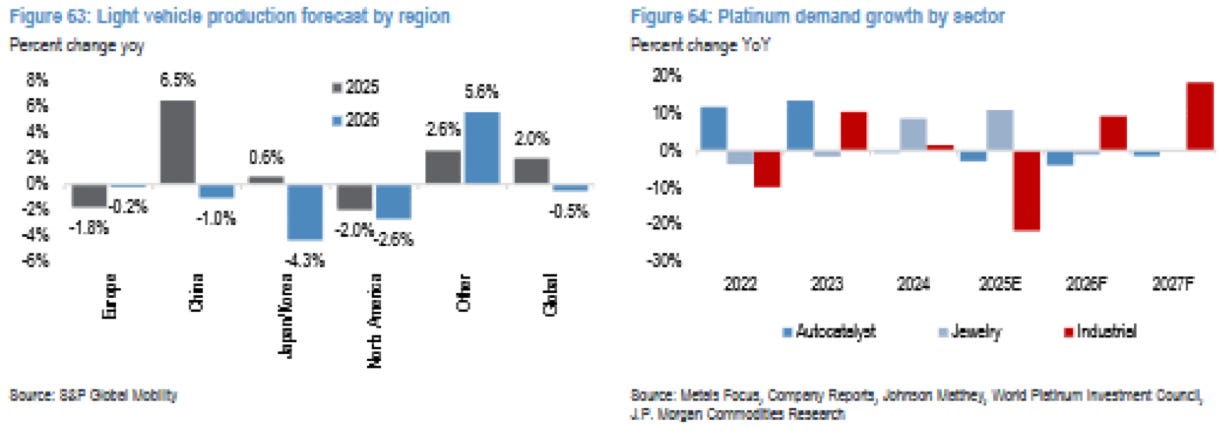
Platinum fabrication demand to recover in 2026/27. After a steep decline in 2025, platinum industrial demand is projected to rise by 9% yoy in 2026. After bottoming out in 2025 following capacity closures in Japan and limited expansions in China, a demand recovery in the cyclical glass industry next year drives the bulk of this growth in industrial demand. Moreover, hydrogen demand is expected to grow steadily over the next few years as the adoption of stationary fuel cells is projected to keep rising, albeit from a low base of only ~50 koz this year. Platinum jewellery fabrication has expanded strongly in 2025 (+11% yoy) as the sharp rise in gold prices widened the price differential between the yellow and white precious metals, driving substitution support. However, we maintain a somewhat cautious stance for 2026 with platinum jewellery demand expected to fall by -1% yoy amid higher sustained prices. All-in-all, after being dragged lower by autocat and industrial demand this year, total fabrication demand for platinum is forecast to rise by ~2% yoy in 2026, and 5% yoy in 2027 driven by a sharp recovery in lumpy industrial demand. In palladium, on the other hand, we see downward pressure on autocat demand next year dragging total fabrication demand lower by about 2% in 2026 (Figure 64).